为什么存在
Why this project exists
科学需求
The scientific need
天文学家想知道星系周围那层看不见的热气体——星系周介质(CGM,circumgalactic medium)——有多重、多热、延展多远。这层气体是星系的"燃料库":恒星形成抛出的物质在这里冷却、回落,超新星与活动星系核把它再加热。要称出它的质量,只能靠它发出的 X 射线。
Astronomers want to know how much mass the invisible hot gas around a galaxy — the circumgalactic medium (CGM) — carries, how hot it is, and how far it reaches. That gas is a galaxy's fuel reservoir: material thrown out by star formation cools and falls back through it, while supernovae and active nuclei reheat it. Weighing it means detecting its X-ray emission.
问题是这层气体的 X 射线极暗:一个典型星系晕的信号,比天空本身的粒子背景还弱。要看到它,唯一的办法是把很多次观测叠在一起(stacking),或者把大面积的拼接图(mosaic)加总。而每一次 XMM-Newton 观测都带着自己的粒子背景和软质子污染,减不干净,叠加就会把仪器效应一起放大。
The difficulty is that this emission is extremely faint: a typical galactic halo signal is weaker than the particle background of the sky itself. The only way to see it is to stack many observations, or to sum a wide mosaic. Every XMM-Newton observation carries its own particle background and soft-proton contamination, and if those are not removed cleanly, stacking amplifies the instrument effects along with the signal.
本项目的总问题用一句话说:同一块天被 XMM EPIC 看到很多次,处理后的光子信号不能取决于它是什么时候、在探测器哪个位置、以哪个滚转角、在哪种 SP 与 QPB 状态下被观测的。做到了,XMM 的 CGM 叠加才有理由;做不到,观测之间的分歧本身就是系统误差的下限,而且可以归到具体工具上。
The umbrella question in one sentence: the processed photon signal from one piece of sky must not depend on when it was observed, where on the detector it fell, at which roll angle, or under which soft-proton (SP) and quiescent-particle-background (QPB) state it was measured. If it holds, stacking XMM data for CGM work is justified; if it does not, the disagreement between observations is the systematic floor, and it can be attributed to a specific tool.
来源:Source: cognition-os/00_AI_BRIEFING.md, cognition-os/02_CURRENT_QUESTION.md, README.md
缺口:仪器效应没有预算
The gap: no budget for instrument effects
XMM-Newton 的 ESAS 流程给出了一套默认的背景扣除:用一个"安静"时段估计粒子背景(QPB),用一个固定形状的模板减软质子(SP)。这些默认值是从哪里来的、有多准,通常没有随数据一起交付。于是出现了这个项目的核心缺口:
The XMM-Newton ESAS pipeline delivers a default background subtraction: a particle background (QPB) estimated from a quiet period, and soft protons (SP) removed with a fixed-shape template. Where those defaults came from, and how accurate they are, is usually not delivered with the data. Hence the gap this project addresses:
- 没有人给出过一个数:同一块天,两次观测的处理结果相差多少个百分点。Nobody had given a number: how many percent do two observations of the same sky differ after processing.
- 没有人区分过:这个差异里多少来自 SP,多少来自 QPB,多少来自 vignetting 或 ARF。Nobody had separated how much of that difference comes from SP, from the QPB, or from vignetting / the ARF.
- 叠加与拼接时,这些差异不会互相抵消,而是按权重平均,于是仪器效应伪装成天空结构。When stacking and mosaicking, those differences do not cancel — they average by weight, so instrument effects masquerade as sky structure.
PI 的目标陈述把缺口写成了三步可验收的改进(2026-10-14,原文照录):抽出的谱要有高信噪比、低 SP、低未分辨点源残差;拟合结果要在同一点指向的多次观测间稳定、在不同离轴角间稳定;成像的面亮度要可靠,同指向叠加一致、不同指向的 mosaic 看不到明显 vignetting。
The PI's goal statement (2026-10-14, verbatim) writes the gap as three checkable improvements: the extracted spectra must have high signal-to-noise, low SP and low unresolved point-source residual; the fitted result must be stable between observations of the same pointing and across off-axis angle; the image surface brightness must be reliable, with same-pointing stacks agreeing and mosaics of different pointings showing no visible vignetting.
来源:Source: cognition-os/02_CURRENT_QUESTION.md, README.md
这个项目的价值
What this project is worth
这个项目不生产新的天体物理发现;它生产的是让别人敢引用 XMM 弥漫辐射测量的那份依据。它有三种交付物:
This project does not produce new astrophysical discoveries; it produces the warrant that lets others quote XMM diffuse-emission measurements. It has three kinds of deliverable:
- 一个被测出来的系统误差预算。同一块天在不同观测间的差异是多少个百分点,其中多少归 SP、多少归 QPB、多少归 vignetting。A measured systematic budget. How many percent the same sky differs between observations, and how much of that is SP, how much the QPB, how much vignetting.
- 两个被修好的工具。发现的问题变成
esas_data_reduction与xsherpa的 issue,修复以带测试的版本发布,本项目再固定版本重测(D015)。Two repaired tools. A finding becomes an issue againstesas_data_reductionorxsherpa; the fix lands as a tested, versioned release, and this project re-tests pinned to that version (D015). - 一套可以照着做的流程。别人拿到同样的数据,能按"如何用手继续"复现每一条结论。A recipe others can follow. Anyone with the same data can reproduce every conclusion by following "How to continue by hand".
举一个已经量化的例子:在考试集的孔径里,0.5-2 keV 的净计数有 67–83 %(WCDFS)、34–65 %(M31)、12–23 %(LMC)来自 Al-K 1.49 keV 与 Si-K 1.74 keV 两条仪器荧光线——它们不在 QPB 模板里、不随 vignetting 衰减,却按 vignetting 后的 ARF 去除,于是面亮度随离轴角上升。不知道这件事,任何 0.5-2 keV 的面亮度斜率都是错的。
One quantified example: in the exam apertures, 67–83 % (WCDFS), 34–65 % (M31) and 12–23 % (LMC) of the 0.5-2 keV net counts come from the Al-K 1.49 keV and Si-K 1.74 keV instrumental fluorescence lines. They are absent from the QPB template and are not vignetted, yet they are divided by the vignetted ARF and exposure, so the surface brightness rises with off-axis angle. Without knowing this, any 0.5-2 keV surface-brightness slope is wrong.
来源:Source: cognition-os/PITFALLS.md, cognition-os/REDTEAM_QUEUE.md, cognition-os/04_DECISION_LOG.md
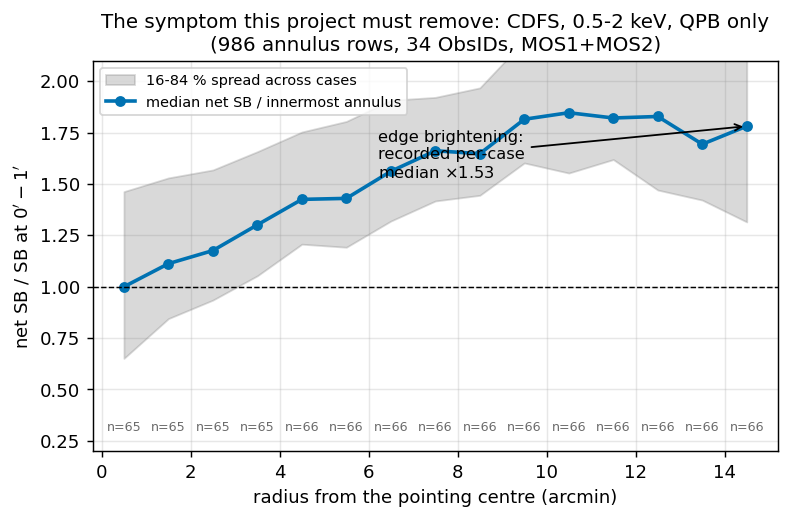
来源:Source: MosaicSelfCal/results/E001_cdfs_radial_edge_20261006/ (986 行剖面 + 每 case 的 edge_over_inner,n = 65,中位数 1.525;信任行 T15/I008 记录为 12-14′ 的 1.54 倍)(986 profile rows plus the per-case edge_over_inner, n = 65, median 1.525; trust row T15/I008 records 1.54x at 12-14')