软质子背景误差主导 XMM-Newton EPIC MOS 拼接图的边缘变亮:一套自校准考试集的初步测量
Soft-proton background errors dominate the edge brightening of XMM-Newton EPIC MOS mosaics: preliminary measurements from a self-calibration exam set
Running head: SP backgrounds and MOS edge brightening
Running head: SP backgrounds and MOS edge brightening
作者:
Authors:
摘要
Abstract
弥漫 X 射线研究依赖把多条 XMM-Newton 观测拼成一张大图,但拼接图常在视场边缘比中心亮。为把这一"边缘变亮"从症状变成可归因的测量,我们构建了一套自校准考试集:7 个固定天区(每个 4′ 宽)、18 个 ObsID、45 个相机\(\times\)观测组合(case),在 0.4–1.25 keV 软带内对同一片天空重复测量,并要求答案跨 case 一致。在 40 个通过质量筛选的 case 上,CDFS 场的边缘/内部净面亮度中位数比达 \(\times1.53\)(63 个径向 case)[s1];M31 场的配对径向斜率(仅扣 QPB)为 \(+1.51\pm0.16\ \%/\text{arcmin}\),逐观测剔除后仍全 \(\ge\) 6\(\sigma\)[s2];平衡的 8–10′ 对 12–14′ 边缘步长为 \(+9.9\pm2.0\ \%\),结构化天空零假设的蒙特卡洛偏置 \(-0.01\ \%\)[s3]。同一 M31 数据上,仅换软质子(SP)空间模板,步长在 \(+0.10\ \%\)(平 SP)到 \(+15.20\ \%\)(光子 vignetting)之间移动;用 SP 自身的硬带模板时为 \(+6.69\pm1.72\ \%\)[s4]。硬带(2–5 keV)真角区示踪测得 SP 每像素计数从 \(2'\)–\(6'\) 到 \(12'\)–\(14'\) 下降 \(0.88\pm0.13\),与 ESAS det 图(0.76)一致,排除平(2.41)与光子 vignetting(4.98)模板[s5]。MOS1/MOS2 SP 归一比在 2012 年出现 \(0.68\pm0.03\to1.47\pm0.11\) 的台阶,面积解释被排除,但台阶与 MOS1 CCD3 丢失及 QPB 模板年代完全退化[s6]。这些测量把边缘变亮从症状收窄到 SP 模板与仪器边缘效应;绝对 SP 水平仍不可测。为他人做弥漫 X 射线工作,我们建议在拼接前明确声明 SP 模板选择,并报告边缘/内部比对其敏感度。
Diffuse X-ray studies rely on combining many XMM-Newton observations into one mosaic, but the mosaics are often brighter at the field edge than at the centre. To turn this edge brightening from a symptom into an attributable measurement, we built a self-calibration exam set: 7 fixed sky cells (each 4 arcmin wide), 18 ObsIDs, 45 camera-observation combinations (cases), measuring the same sky repeatedly in the 0.4–1.25 keV soft band and requiring the answers to agree across cases. On the 40 cases that pass quality screening, the CDFS field has a median edge-to-inner net surface brightness ratio of \(\times1.53\) (63 radial cases)[s1]; the M31 field has a paired radial slope (QPB subtracted only) of \(+1.51\pm0.16\ \%/\text{arcmin}\), still \(\ge 6\sigma\) under leave-one-observation-out[s2]; and a balanced 8–10 arcmin versus 12–14 arcmin edge step of \(+9.9\pm2.0\ \%\), with a structured-sky Monte Carlo null bias of \(-0.01\ \%\)[s3]. On the same M31 data, changing only the soft-proton (SP) spatial template moves the step between \(+0.10\ \%\) (flat SP) and \(+15.20\ \%\) (photon vignetting); with SP's own hard-band template it is \(+6.69\pm1.72\ \%\)[s4]. A hard-band (2–5 keV) true-corner tracer measures the SP per-pixel count falling by \(0.88\pm0.13\) from 2–6 to 12–14 arcmin, consistent with the ESAS det map (0.76) and excluding the flat (2.41) and photon-vignetting (4.98) templates[s5]. The MOS1/MOS2 SP-normalisation ratio steps in 2012 from \(0.68\pm0.03\) to \(1.47\pm0.11\); the area explanation is refuted, but the step is perfectly degenerate with the MOS1 CCD3 loss and the QPB-template epoch[s6]. These measurements narrow the edge brightening to the SP template and instrumental-edge effects; the absolute SP level remains unmeasurable. For others doing diffuse X-ray work, we recommend stating the SP template choice explicitly before mosaicking, and reporting the sensitivity of the edge-to-inner ratio to it.
关键词:X 射线天文学;弥漫 X 射线背景;天文数据减除;校准;XMM-Newton
Keywords: X-ray astronomy; Diffuse x-ray background; Astronomy data reduction; Calibration; XMM-Newton
1 引言
1 Introduction
银河系外的弥散 X 射线辐射——热星系晕、星系团内介质、宇宙 X 射线背景的未分辨成分——是理解重子循环与能量反馈的关键探针。要把这些信号从数据里挖出来,通常要把同一天区的多条 XMM-Newton 观测拼成一张深度足够的图。EPIC(European Photon Imaging Camera,XMM-Newton 的三台成像相机:MOS1、MOS2 与 pn)因为有效面积大、能谱分辨率适中,是这类弥漫辐射工作的主力仪器(Jansen et al. 2001;Strüder et al. 2001;Turner et al. 2001)。
Diffuse X-ray emission outside the Milky Way — the hot gaseous halo, the intracluster medium, and the unresolved cosmic X-ray background — is a key probe of baryon cycling and feedback. Extracting it usually requires combining many XMM-Newton observations of the same sky area into one deep mosaic. EPIC (the European Photon Imaging Camera, XMM-Newton's three imaging cameras MOS1, MOS2 and pn) is the workhorse for such work because of its large effective area and moderate spectral resolution (Jansen et al. 2001; Strüder et al. 2001; Turner et al. 2001).
问题在于,弥漫信号本身比它所在的背景弱。EPIC 的视场里同时存在两类非天空成分:准静态粒子背景 QPB(quiescent particle background,高能带电粒子打在探测器上产生的计数,不受望远镜 vignetting 影响,可用滤光轮关闭校准数据 FWC 归一)与软质子 SP(soft protons,被地磁场聚焦的太阳风/磁层低能质子,随时间涨落、空间分布未定)。弥漫辐射减除流程 ESAS 用视场外的角区(corner)示踪 QPB、用耀发时间图示踪 SP(Kuntz & Snowden 2008;Snowden et al. 2008;Kuntz & Snowden 2000)。两种成分的模板若不准,误差会直接叠加在想要的天文信号上。
The difficulty is that the diffuse signal is faint compared with the background it sits on. The EPIC field of view contains two non-sky components: the quiescent particle background (QPB; counts from energetic particles hitting the detector, unaffected by telescope vignetting, normalised from filter-wheel-closed calibration data) and the soft protons (SP; solar-wind and magnetospheric protons focused by the Earth's magnetic field, time-variable, with an unknown spatial distribution). The ESAS diffuse-emission reduction traces the QPB from the out-of-field-of-view corners and the SP from flare time maps (Kuntz & Snowden 2008; Snowden et al. 2008; Kuntz & Snowden 2000). Errors in either template land directly on the astronomical signal.
这类误差最直观的症状,就是拼接图的"边缘变亮"(edge brightening):同一片天空,靠近视场边缘的净面亮度系统性地高于中心。它是弥漫 X 射线工作者最熟悉的观感问题——但"观感"不等于归因:它可能来自 SP 模板的形状、QPB 的角区归一、仪器响应本身,也可能真的是天空结构。在没有一个能跨观测重复、跨相机一致地测量同一片天空的框架之前,任何一方的声称都无法被独立检验。本项目要解决的正是这个缺口。
The most visible symptom of such errors is edge brightening: the net surface brightness of the same sky is systematically higher near the field edge than at the centre. It is the most familiar visual problem in diffuse X-ray work — but a visual impression is not an attribution: it could come from the SP template shape, from the QPB corner normalisation, from the instrumental response, or it could be a real sky structure. Without a framework that measures the same sky repeatedly and consistently across observations and cameras, no claim about it can be checked independently. Closing that gap is what this project sets out to do.
关于 SP 的空间分布,文献里已知的是:它随时间变化、比光子更不受 vignetting 影响(Kuntz & Snowden 2008),以及耀发图(flare maps)是它在 ESAS 流程里的默认示踪。关于它在软带(0.4–1.25 keV,正是边缘变亮所在的能段)的形状,据我们所知没有被独立测量过——硬带示踪在软带没有信号,QPB 又只占软带计数的一小部分[s7]。同样,两条指向几乎相同的重复观测能否给出 SP 绝对水平,此前没有定量结论;我们把它测成了上限而非零[s8]。
What the literature establishes about the SP distribution is that it varies with time, is less vignetted than photons (Kuntz & Snowden 2008), and that flare maps are its default tracer in the ESAS workflow. Its shape in the soft band (0.4–1.25 keV, where the edge brightening lives) has, to our knowledge, not been measured independently — hardness tracers have no soft-band signal, and the QPB is only a small fraction of the soft-band counts[s7]. Likewise, whether two nearly identical repeat pointings can yield the absolute SP level had no quantitative answer; we measure it as an upper limit, not a null[s8].
因此本文报告的不是"边缘变亮被解决了",而是一个可重复测量框架的建立与第一批测量结果。我们的做法是自校准考试集(self-calibration exam set):选 7 个固定天区(每个 4′ 宽)、18 个 ObsID,组成 45 个"相机\(\times\)观测"case;同一片天空在不同离轴角、不同年代、不同 SP/耀发条件下被反复观测,任何对天空成分的声称都必须在所有 case 上给出一致的答案。第 2 节给出观测与减除,第 3 节按"先测量、后解释"的顺序报告五组结果,第 4 节讨论这些结果把归因收窄到什么程度、以及哪些问题仍然开放,第 5 节总结。
This paper therefore reports not a solution to edge brightening but the construction of a repeatable measurement framework and its first measurements. Our approach is a self-calibration exam set: 7 fixed sky cells (each 4 arcmin wide) and 18 ObsIDs, forming 45 camera-observation combinations (cases); the same sky is observed repeatedly at different off-axis angles, in different epochs, and under different SP and flaring conditions, so any claim about a sky component must give consistent answers across all cases. Section 2 describes the observations and reduction; Section 3 reports five groups of results in the order measurement before interpretation; Section 4 discusses how far the attribution is narrowed and what remains open; Section 5 summarises.
2 观测与数据减除
2 Observations and data reduction
本节回答两个问题:数据从哪来、按什么规则筛选,以及它们怎样被减除到可以比较的状态。考试集的设计见图 1:同一块 4′ 固定天区被多条指向略异的观测以不同离轴角反复采样。
This section answers two questions: where the data come from and by what rules they were screened, and how they were reduced to a comparable state. Figure 1 shows the exam-set design: the same fixed 4 arcmin cell is sampled repeatedly by observations with slightly different pointings and therefore different off-axis angles.
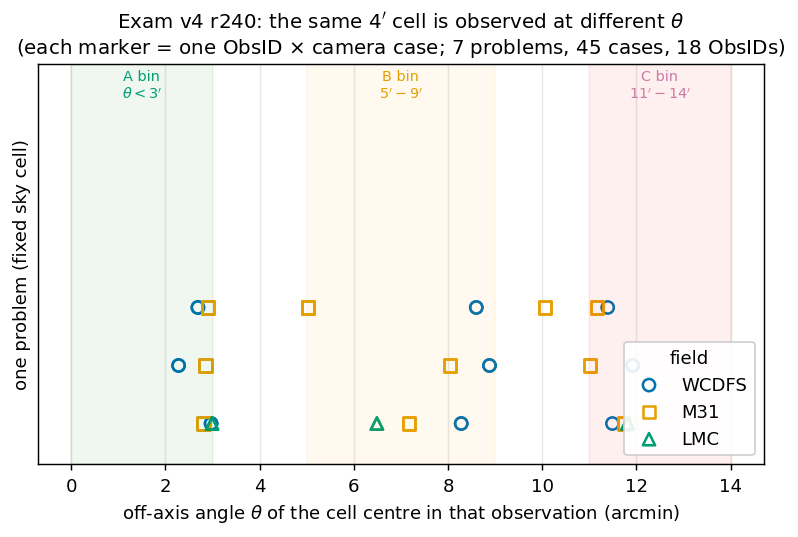
MosaicSelfCal/problems/v4/r240/{WCDFS,M31,LMC}/problems.csv。Figure 1: the exam-set design. The same fixed sky cell (problem) is observed by 18 ObsIDs at different off-axis angles, each ObsID \(\times\) camera forming one case; off-axis angles use the pointing angles (RA_PNT/DEC_PNT), not the archive target coordinates — the two differ by up to 1.76 arcmin, enough to change the radial binning[s9]. Source: MosaicSelfCal/problems/v4/r240/{WCDFS,M31,LMC}/problems.csv.数据来自 XMM-Newton 科学档案的公开观测,覆盖 CDFS、M31 与 LMC 三个方向。筛选规则先于分析固定:干净曝光(扣掉耀发后)低于 20 ks 的 case 排除在分数之外,因为短曝光的边缘/内部比被统计涨落主导[s10]。筛选后剩 40 PASS、5 EXCLUDED,共 45 个 case、18 个 ObsID、7 个 problem;状态表与审计对账在建立时冻结,本手册 2026-10-19 复算一致[s11]。MOS1 与 MOS2 是基准相机;pn 只做交叉检查,因为它的 QPB 归一被高估 2–29 %[s12]。
The data are public XMM-Newton Science Archive observations covering the CDFS, M31 and LMC directions. The screening rules were fixed before any analysis: cases with clean exposure (after flare removal) below 20 ks are excluded from the scores, because short exposures make the edge-to-inner ratio statistics-dominated[s10]. After screening, 40 cases PASS and 5 are EXCLUDED, out of 45 cases, 18 ObsIDs and 7 problems; the status table and its audit reconciliation were frozen at construction, and this handbook recomputed them consistently on 2026-10-19[s11]. MOS1 and MOS2 are the baseline cameras; pn is a cross-check only, because its QPB normalisation is over-estimated by 2–29 %[s12].
| 项目Item | 值Value | 来源Source |
|---|---|---|
| problem(固定天区)数problems (fixed sky cells) | 7 | MosaicSelfCal/results/exam_v4_r240/status.csv |
| ObsID 数ObsIDs | 18 | MosaicSelfCal/results/exam_v4_r240/status.csv |
| case(相机\(\times\)观测)总数total cases (camera \(\times\) observation) | 45 | MosaicSelfCal/results/exam_v4_r240/SUMMARY.md line "total=45" |
| PASS / EXCLUDEDPASS / EXCLUDED | 40 / 5 | MosaicSelfCal/results/exam_v4_r240/SUMMARY.md line "EXCLUDED=5, PASS=40" |
| EXCLUDED 判据EXCLUDED criterion | 干净曝光 < 20 ksclean exposure < 20 ks | cognition-os/04_DECISION_LOG.md D020 |
| 径向 case 数(CDFS 边缘诊断)radial cases (CDFS edge diagnostic) | 63 | MosaicSelfCal/results/E001_cdfs_radial_edge_20261006/unvignetted_fit.csv |
表 1:考试集构成。完整 ObsID 清单(含曝光、干净时间与离轴几何)见MosaicSelfCal/results/exam_v4_r240/。
Table 1: the composition of the exam set. The full ObsID list, with exposures, clean times and off-axis geometry, is in MosaicSelfCal/results/exam_v4_r240/.
减除用 SAS + ESAS 流程(mos-spectra、mos_back 等任务),QPB 由视场外角区加滤光轮关闭(FWC)模板归一,点源掩膜用 ESAS cheese 产品(1 = 可用)。谱拟合用 CIAO/Sherpa 及其上的本项目前端 xsherpa,天空成分取本地泡(local bubble)、银河晕、0.7 keV apec 热晕与未分辨宇宙 X 射线背景(CXB)四项;拟合统计量在未扣减谱上用 Cash 统计量(cstat)。有一处必须声明的取舍:ESAS 的角区定义与 FLAG 掩膜的角区定义不同(半径 2.48 对 3.39),本工作一律用 ESAS 定义[s13]。
The reduction used the SAS + ESAS workflow (the mos-spectra, mos_back and related tasks); the QPB was normalised from the out-of-field corners plus filter-wheel-closed (FWC) templates, and point sources were masked with the ESAS cheese product (1 = usable). Spectral fitting used CIAO/Sherpa and this project's front-end xsherpa on top of it, with four sky components: the local bubble, the Milky Way halo, a 0.7 keV apec hot halo, and the unresolved cosmic X-ray background (CXB); the fit statistic is the Cash statistic (cstat) on un-subtracted spectra. One caveat must be stated: the ESAS corner definition differs from the FLAG-mask corner definition (radius 2.48 versus 3.39), and this work uses the ESAS definition throughout[s13].
3 结果
3 Results
本节按"先测量、后解释"的顺序报告五组结果:先确认边缘变亮在两个场上都真实存在(3.1),再测量 SP 自己的空间分布(3.2),然后量化 SP 模板选择对答案的影响(3.3),接着检验重复指向给出的 SP 绝对水平上限(3.4),最后报告 MOS1/MOS2 相机归一在 2012 年的台阶(3.5)。除特别说明外,误差棒为 1\(\sigma\)(蒙特卡洛或拟合协方差给出),置信水平在每小节开头声明。
This section reports five groups of results in the order measurement before interpretation: first, that edge brightening is real in both fields (3.1); then SP's own spatial distribution (3.2); then how much the SP template choice moves the answer (3.3); then the upper limit that repeat pointings place on the absolute SP level (3.4); and finally the 2012 step in the MOS1/MOS2 camera normalisation (3.5). Unless stated otherwise, error bars are 1\(\sigma\) (from Monte Carlo or the fit covariance) and the confidence level is stated at the start of each subsection.
3.1 边缘变亮在两个场上都真实存在
3.1 Edge brightening is real in both fields
我们首先问:把背景按 ESAS 流程减掉之后,边缘/内部比是否仍然升高?在 CDFS 的 63 个径向 case 上,边缘对内部的净面亮度中位数比为 \(\times1.53\)[s1](图 2)。在 M31 上用两种独立的统计量复核:配对径向斜率(仅扣 QPB)\(+1.51\pm0.16\ \%/\text{arcmin}\),逐观测剔除后区间 \(+1.19\) 到 \(+2.12\),全部 \(\ge\) 6\(\sigma\)[s2];平衡的 8–10′ 对 12–14′ 边缘步长 \(+9.9\pm2.0\ \%\)。为排除"结构化天空本身就能造出这个步长",我们用同一流程跑结构化天空零假设,偏置 \(-0.01\ \%\),蒙特卡洛 sd/\(\sigma\) = 0.98[s3]。两种统计量一致给出正的边缘超额,且零假设检验表明它不是天空结构的产物。这一节确立的是"测量",不是"归因":下面三节逐个检验可能的来源。
We first ask whether the edge-to-inner ratio is still elevated after the background has been removed with the ESAS workflow. On the 63 CDFS radial cases, the median edge-to-inner net surface brightness ratio is \(\times1.53\)[s1] (Figure 2). On M31 we checked this with two independent statistics: the paired radial slope (QPB subtracted only) is \(+1.51\pm0.16\ \%/\text{arcmin}\), and under leave-one-observation-out it ranges from \(+1.19\) to \(+2.12\), always \(\ge 6\sigma\)[s2]; the balanced 8–10 arcmin versus 12–14 arcmin edge step is \(+9.9\pm2.0\ \%\). To exclude the possibility that a structured sky alone produces this step, we ran the same pipeline on a structured-sky null: the bias is \(-0.01\ \%\), with Monte Carlo sd/\(\sigma\) = 0.98[s3]. Both statistics give a positive edge excess, and the null test shows it is not an artefact of sky structure. What this section establishes is the measurement, not the attribution: the next three sections test the possible sources one by one.
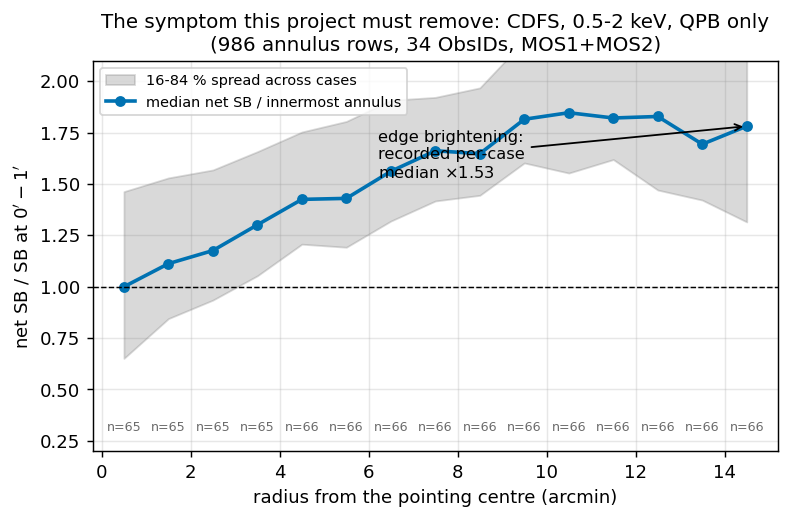
MosaicSelfCal/results/E001_cdfs_radial_edge_20261006/。Figure 2: the radial profile of the CDFS net surface brightness, rising outward. The vertical axis is net surface brightness (QPB subtracted, point sources masked); the horizontal axis is the angular distance to the field edge; the shading is the spread across cases. Source: MosaicSelfCal/results/E001_cdfs_radial_edge_20261006/.3.2 SP 自己的空间分布接近 ESAS det 图,平模板与光子 vignetting 被排除
3.2 SP's own spatial distribution is close to the ESAS det map; flat and photon-vignetted templates are excluded
软带里 SP 的形状测不到(硬度示踪在软带没有信号,QPB 只占软带计数的 18 %[s7]),所以我们在硬带 2–5 keV 用真正的视场外角区做示踪:这个能段里几乎没有天空光子,角区计数几乎全是粒子。原始 SP 每像素计数从 2′–6′ 到 12′–14′ 下降 \(0.88\pm0.13\)[s5]。同一组数据上,三种候选模板的拟合优度为:ESAS det 图 0.76(最好,\(\chi^2_\nu=1.74\))、均匀 2.41、光子 vignetting 4.98(被排除)。也就是说,SP 的空间分布既不是平的,也不遵循光子的 vignetting 曲线,而是接近 ESAS 的 det 图。
SP's shape is not measurable in the soft band (hardness tracers have no soft-band signal, and the QPB is only 18 % of the soft-band counts[s7]), so we traced it in the hard band 2–5 keV using the true out-of-field corners: at these energies there are almost no sky photons, so the corner counts are nearly all particles. The raw SP per-pixel count falls by \(0.88\pm0.13\) from 2–6 to 12–14 arcmin[s5]. On the same data, the goodness of fit of the three candidate templates is: the ESAS det map, 0.76 (best, \(\chi^2_\nu=1.74\)); flat, 2.41; photon vignetting, 4.98 (excluded). In other words, SP's spatial distribution is neither flat nor does it follow the photon vignetting curve; it is close to the ESAS det map.
这条结果有一个必须声明的窗口依赖:把"排除平模板"的结论按径向窗口拆开看,2–4′ 窗口的 2.41\(\sigma\) 异常撑起了它的一部分权重[s14];因此本小节列为初步(under review),其"接近 det 图"的主结论不受影响。
One window dependence must be declared: breaking the "flat rejected" conclusion down by radial window, the 2–4 arcmin window's 2.41\(\sigma\) anomaly carries part of its weight[s14]; this subsection is therefore labelled preliminary (under review), while its main conclusion — close to the det map — is unaffected.